



Getting to grips with demand
“In the last 10 years,” says Mike Rigby, MRA Research, “disease, war, climate, and world powers competing for a bigger slice of the pie have rolled back globalisation and shrunk our markets. The supply chain needs to focus on demand now, not just supply.”
 In a recent letter to John Healey, the new Chancellor of the Exchequer, Paul Adeleke, the new Chief Executive of the Mineral Products Association, summed up the challenges for the Government and construction: “First and foremost is the lack of growth in the economy, especially in construction… Domestic cement production is at 1950s levels, and ready-mixed concrete sales from our members at levels last seen in the 1960s… Given the scale of this continuing decline, industrial capacity is being lost… if this does come to pass, aspirations of delivering housing or infrastructure in the future will become even harder to deliver.” It’s an excellent letter. Let’s hope the new Chancellor gets it.
Landing in my mailbox at the same time, Paul Hetherington’s latest ‘must-read’ blog, The Owls View connects the dots. Between merchant pricing asymmetry, profitability drift, acquisitions as strategy, the internet, pricing transparency, the squeeze on merchants, buying groups and the relentless squeeze on manufacturers he covers a lot of ground.
Some may resist his argument, but I agree with what he says and would take it further. His blog is worth reading in full, but the gist of what he says is that over the last 25 years three powerful forces have transformed the industry.
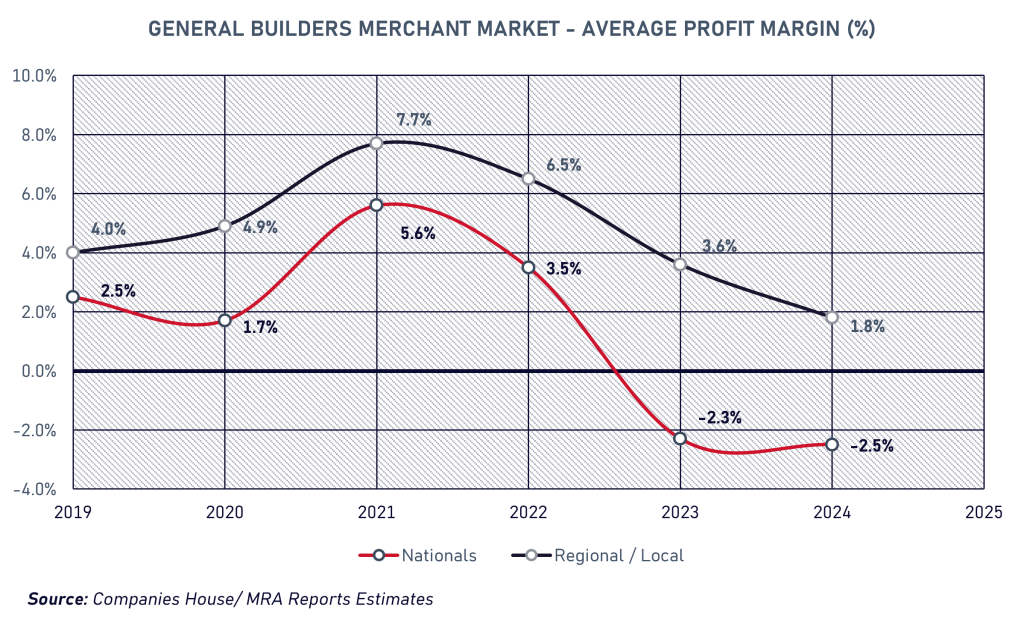
First, buying groups have given independent merchants the buying power to compete with the nationals, effectively levelling the playing field. You can see the impact on pre-tax profits in the chart from MRA Building Market Reports’ Builders’ Merchants Report.
Second, the internet has acted slowly, making pricing transparent and eroding merchant’s pricing advantage. Prices and price lists were just starting points for negotiations, and opacity favoured merchants. The gradual removal of that advantage has inexorably eroded merchants’ margins and fuelled the growth of Screwfix and the fixed-priced no-negotiation model.
Finally, private equity has acquired a large share of the market. With that change in ownership comes an abrupt transition from long time horizons and what is good for the business, customers and industry to relatively short time horizons based on the need to sell and flip to exit with attractive returns on their investment in 5-7 years. Typically, private equity borrows large amounts of debt to make the acquisition and sells in a relatively short term. At the end of five to seven years – in strong or weak markets – private equity sells on to extract the returns that make the acquisition worthwhile. But after every flip there are fewer efficiencies left for a new owner to find, so that leads inevitably to cutbacks and a squeeze on suppliers.
Looking to the future, Paul sees five powerful trends.
1 The survivors will be service businesses, not box shifters like Amazon and Screwfix. Merchants who try to compete with them will lose their shirts.
2 There are still too many branches serving too few customers. So, there will be consolidation and failures.
3 Transparent AI-driven pricing will drive out ambiguous foggy pricing within five years.
4 Buying groups must evolve from just buying better to helping members sell better, and progress from supply to supply and demand.
5 Manufacturing suppliers are going direct to specifiers. I’d add that great suppliers have always generated specifications and managed the whole supply chain from specification to finish through merchants to builders and trades. But they need good margins to develop new products and services and build installer communities for merchants. Squeeze too hard and they will look to find more sustainable, alternative routes to market.
Construction is a very large and important sector. Even now it’s over 6% of the UK economy, Directly and indirectly one in ten people work in it. And yet it’s an inward-looking, uncommunicative sector that punches below its weight and struggles to make itself understood.
To put this in perspective, Agriculture, a much smaller industry has a far bigger voice. Dame Angela Eagle the Secretary of State for Environment, Food and Rural Affairs, speaks for agriculture in the cabinet. Two long-running radio programmes, The Archers and Farming Today, bang the drum for agriculture and communicate its points of view, and Clarkson’s Farm also shouts out for farming and farmers. When the Government doesn’t listen or does something that harms agriculture, farmers get in their tractors and camp outside parliament.
“When the pie was growing,” Paul says, “everyone could pretend the model worked. With volumes at crisis levels, the pretence is over.”
We can’t reply on Government to grow the market for the good of the industry and country. Even when they get the words right, Government gets distracted and doesn’t know how. So, it’s down to us to come together and find a way. That’s the challenge.
Contenders for Supplier of The Year Award have done brilliantly in some of the most difficult conditions the industry has faced. They deserve our wholehearted respect and admiration.
MRA Research sponsors the Supplier of Year category at the Builders Merchants’ Awards, which takes place on 27th November 2026.
